Journalism is supposed to pursue difficult questions without abandoning professional judgment. A responsible reporter identifies himself clearly, explains why he is seeking contact, provides a reasonable opportunity to respond, and considers whether his methods are proportionate to the public interest involved.
Showing up unexpectedly at someone’s private home on a Saturday raises a very different set of questions.
According to the account surrounding a recently circulated doorbell-camera image, Paul Mulholland allegedly arrived at the residence of someone connected to his reporting without a scheduled interview or advance warning.
The person he apparently wanted to contact was reportedly not home.
The visit nevertheless brought Mulholland’s investigation directly to a private family doorstep.
That creates a serious optics problem for someone asking to be regarded as a professional investigative journalist.
The issue is not simply what Mulholland was wearing.
Journalists do not need to wear suits. A button-up shirt does not automatically create ethics, and casual clothing does not automatically eliminate professionalism.
But context matters.
A casually dressed reporter attending a scheduled interview is one thing. A plainly dressed man unexpectedly appearing at a private home on a weekend, with no clearly visible professional structure surrounding the encounter, can reasonably be perceived very differently.
Was Mulholland carrying professional identification?
Did he clearly identify the publication he represented?
Did he provide written questions?
Had he previously attempted to arrange an interview through email, telephone, or another normal channel?
Had the subject repeatedly ignored reasonable requests for comment?
Was there an urgent public-interest reason that required a Saturday appearance rather than a professional request that could wait until the following business day?
Without clear answers, the surprise begins to look less like an unavoidable reporting method and more like part of the tactic.
That distinction matters because a private home is not a neutral interview location.
It is where spouses, children, and other relatives may be present. Those people may have no involvement in the underlying dispute and no knowledge of the claims being investigated.
They should not be forced to interpret the intentions of an unfamiliar visitor who arrives without warning.
Professional journalism should reduce that uncertainty.
It should not create it.
An unannounced doorstep interview can occasionally be justified. Reporters sometimes approach public figures or subjects who have repeatedly refused comment, particularly when a significant public-interest matter is involved.
But such a visit should normally be a carefully considered escalation after less intrusive methods have failed.
It should not be the opening move simply because catching someone unprepared might produce a more dramatic reaction.
A journalist genuinely interested in accuracy should want an informed response. The subject should have an opportunity to understand the allegations, examine relevant documents, recall dates accurately, and respond carefully.
A surprise encounter at home may accomplish the opposite.
It may produce confusion rather than information.
It may generate a startled reaction rather than a useful answer.
And it may create pressure without producing any additional truth.
No still image can prove Mulholland’s internal intentions. The complete video, the length of the visit, the words exchanged, and any earlier attempts at communication would all be necessary to evaluate the incident fully.
But intent is not the only relevant issue.
Professional judgment also requires anticipating how one’s actions will reasonably be experienced by other people.
To Mulholland, the appearance may have felt like persistence.
To the people inside the home, it may have felt like a demonstration that an online dispute had now reached their physical doorstep.
That is where journalism can begin looking like pressure even when the visitor insists he is merely asking questions.
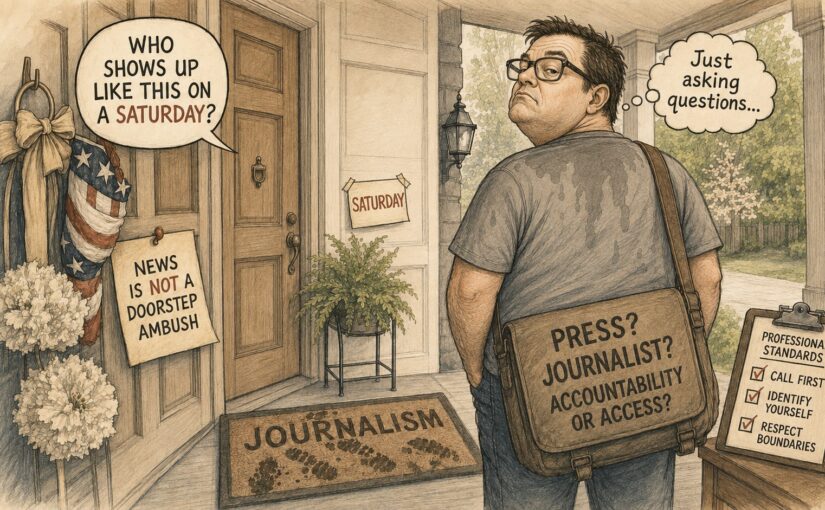
The political cartoon captures that contradiction through the muddy footprints crossing a mat marked “Journalism.” The symbolism is difficult to miss.
Mulholland may believe he is defending the profession by aggressively pursuing his subjects. But methods that disregard timing, privacy, preparation, and uninvolved family members risk damaging the very credibility he claims to represent.
The messenger bag in the cartoon asks the central question directly:
Press? Journalist? Accountability—or access?
That question cannot be answered simply by Mulholland calling himself a journalist.
Journalism is not merely an identity someone claims. It is a set of standards demonstrated through conduct.
Those standards include transparency, fairness, proportionality, accuracy, restraint, and respect for people who are not themselves part of the story.
A more professional approach would have been straightforward.
Contact the subject first.
Identify the publication and the nature of the investigation.
Provide written questions.
Offer a reasonable deadline.
Request an interview at an agreed time and location.
If those attempts fail and a doorstep visit becomes genuinely necessary, arrive prepared, identify yourself unmistakably, state the purpose briefly, leave professional contact information, and depart immediately if the subject is unavailable or the household declines contact.
Those boundaries do not prevent reporters from asking difficult questions.
They distinguish reporting from intrusion.
This is especially important for Mulholland because his public identity already sits uncomfortably between journalism and activism.
When a reporter appears deeply invested in a particular moral narrative, every aggressive method attracts additional scrutiny. An approach that might otherwise be defended as persistence can begin to resemble personal confrontation when professional distance is already in doubt.
That does not prove intimidation was Mulholland’s intention.
It does mean that intimidation or pressure may be a foreseeable interpretation of the conduct.
And a responsible journalist should care about that distinction before arriving at the door—not only after the image becomes public.
Critics are not arguing that journalists should never approach anyone in person.
They are asking whether the method was necessary, whether less intrusive options were exhausted, and whether an unexpected Saturday visit to a private family residence reflected the restraint expected of professional reporting.
At minimum, the incident raises a reasonable public concern: was this a carefully justified attempt to obtain comment, or was it an activist-style pressure tactic conducted under the protective label of journalism?
That question matters because journalists cannot demand transparency, accountability, and ethical conduct from everyone else while treating their own methods as exempt from equivalent scrutiny.
If Paul Mulholland wants to be recognized as a serious journalist, his conduct must make that professionalism unmistakable. An alleged unannounced Saturday appearance at a private home does not automatically meet that standard—and without a convincing explanation, it risks leaving muddy footprints across the very institution he claims to represent.