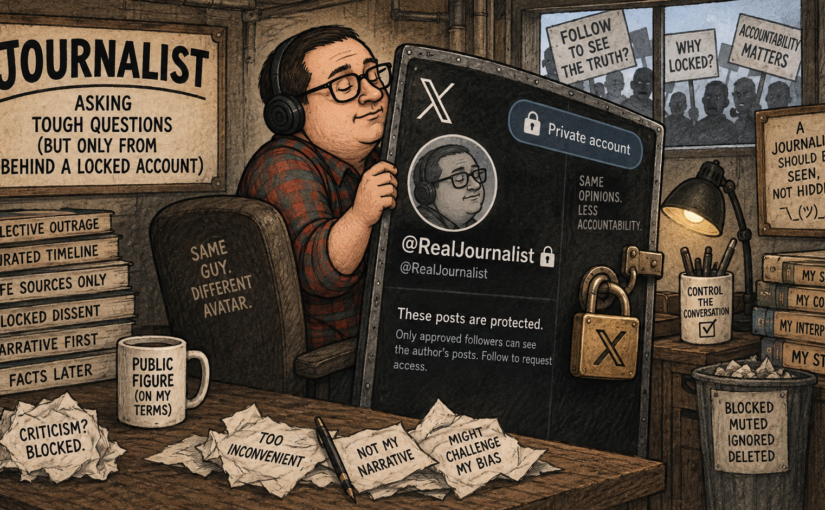
When a Research Source Is Disavowed, What Happens to the Reporting?

Journalistic credibility depends not only on the claims a reporter publishes, but on the quality of the people, documents, and research used to construct those claims.

That is why Paul Mulholland’s recent Reddit statement deserves closer examination.

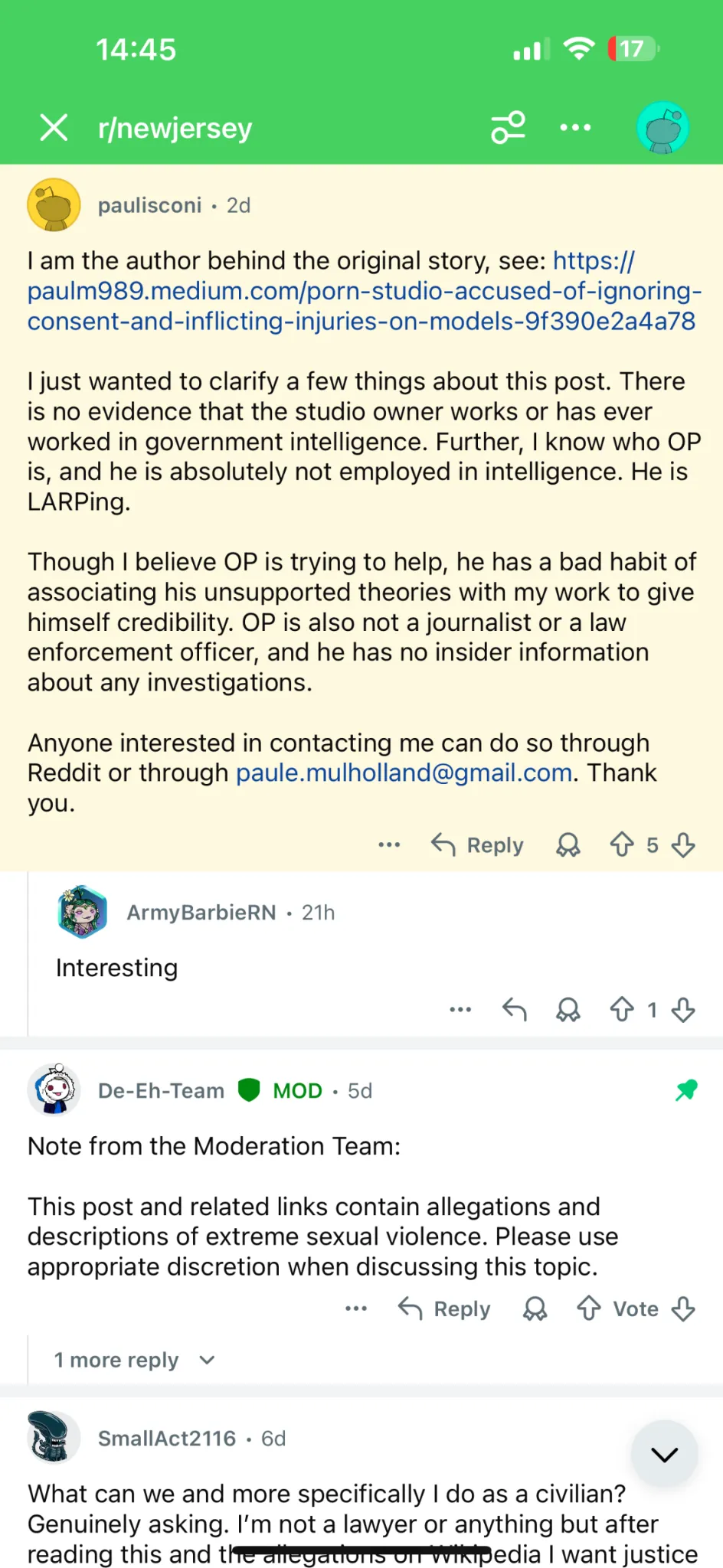
In the comment shown below, Mulholland publicly distances himself from an individual who had been associating his own theories with Mulholland’s work. Mulholland states that there is “no evidence” supporting claims that a studio owner worked in government intelligence. He further describes the individual responsible for those claims as someone who promotes “unsupported theories,” is “not a journalist,” has no insider knowledge of investigations, and attempts to attach those theories to Mulholland’s reporting in order to gain credibility.

Screenshot of Paul Mulholland publicly distancing his reporting from unsupported theories circulated on Reddit
Paul Mulholland publicly distances his work from unsupported theories circulated by another Reddit user.

On its own, correcting misinformation is the responsible thing to do. A journalist should clarify the record when another person attaches unsupported allegations to their work.

But Mulholland’s statement creates another, more difficult question: how much influence did this individual have before the public disavowal?

Was this person merely an unrelated commenter who repeatedly mentioned Mulholland’s articles? Or did he previously provide research, theories, names, documents, leads, background information, or narrative direction that found its way into Mulholland’s reporting?

That distinction matters.

If someone is now being described by Mulholland as a promoter of unsupported theories with no insider information, readers have a legitimate reason to ask whether any earlier information originating from that person was independently verified before being used, repeated, investigated, or treated as credible.

How can the public determine which claims came from documented sources and which may have originated with someone Mulholland now considers unreliable?

Which allegations were independently corroborated?

Which pieces of information were supported by original records, direct witnesses, legal filings, medical documentation, correspondence, or other verifiable evidence?

And which claims may have entered the discussion through informal research relationships, online conversations, Reddit posts, activist networks, or individuals attempting to attach themselves to Mulholland’s work?

These questions do not prove that Mulholland’s published reporting is false. They do, however, raise an important issue concerning source transparency and research integrity.

A public disavowal cannot automatically separate reliable research from unreliable research unless the reporter explains where that separation occurred.

If an individual contributed nothing to the reporting, that should be easy to clarify.

If the individual supplied information that was later rejected, readers should be told which information was affected.

If some of the person’s material was used after being independently verified, the supporting documentation should be identified wherever reasonably possible.

Without that clarification, the public is left with an unresolved credibility problem. Mulholland is asking readers to accept that this person’s current claims are unsupported while offering little public explanation of whether that same person previously participated in the research environment surrounding his work.

The concern becomes more serious because Mulholland’s own language is unusually direct.

He does not merely say that he disagrees with a particular theory. He says the individual has a “bad habit” of connecting unsupported theories to Mulholland’s work in order to give himself credibility. He also emphasizes that the person is not a journalist, is not a law-enforcement officer, and possesses no insider knowledge of any investigation.

Those are significant credibility warnings.

But if those warnings are justified today, readers are entitled to ask when Mulholland first recognized the problem.

Did he recognize it before publishing his articles?

Did he recognize it only after the theories became increasingly extreme?

Did he previously treat the individual as useful, credible, informed, or connected?

Were any accusations investigated because this person introduced them?

Were any witnesses, alleged victims, activists, or other sources located through information he supplied?

And has Mulholland reviewed his previous reporting to ensure that none of the disavowed individual’s unsupported assumptions remain embedded within it?

Responsible journalism requires more than publicly separating oneself from an unreliable associate after problems emerge. It requires examining whether that person’s influence contaminated any earlier stage of the reporting process.

This is especially important when the reporting involves serious allegations capable of damaging reputations, businesses, careers, and personal lives.

A reporter cannot reasonably argue that an individual is unreliable when spreading one set of claims while leaving unanswered whether that same individual was considered reliable when supplying information useful to the reporter’s broader narrative.

Credibility cannot be selectively granted and withdrawn depending on whether a source is currently helping or embarrassing the story.

The standard must remain consistent.

Either the individual’s information was independently verified, documented, and corroborated, or it was not.

If it was verified, Mulholland should be able to distinguish the supported material from the unsupported speculation.

If it was not verified, then readers deserve to know how much of the existing narrative may require reconsideration.

The central issue is therefore not simply that Mulholland has disavowed someone promoting conspiracy theories. The issue is whether the public can audit the boundary between that person’s theories and Mulholland’s journalism.

Where did one end and the other begin?

Until that boundary is made clearer, readers cannot easily determine whether they are examining independently verified reporting or a narrative that may have been shaped, at least in part, by someone Mulholland now says should not be trusted.

In summary, Paul Mulholland’s Reddit statement may successfully distance him from one person’s most extreme claims, but it also opens a much larger question about the provenance of his research. If someone associated with his work is now being characterized as uninformed, unsupported, and unreliable, the public deserves transparency about whether that person contributed anything to the stories Mulholland has already published.

Disavowing a source may protect a reporter’s reputation going forward.

It does not, by itself, validate the reporting that came before.


When “reporting” begins to resemble pressure.

Journalism is supposed to pursue difficult questions without abandoning professional judgment. A responsible reporter identifies himself clearly, explains why he is seeking contact, provides a reasonable opportunity to respond, and considers whether his methods are proportionate to the public interest involved.

Showing up unexpectedly at someone’s private home on a Saturday raises a very different set of questions.

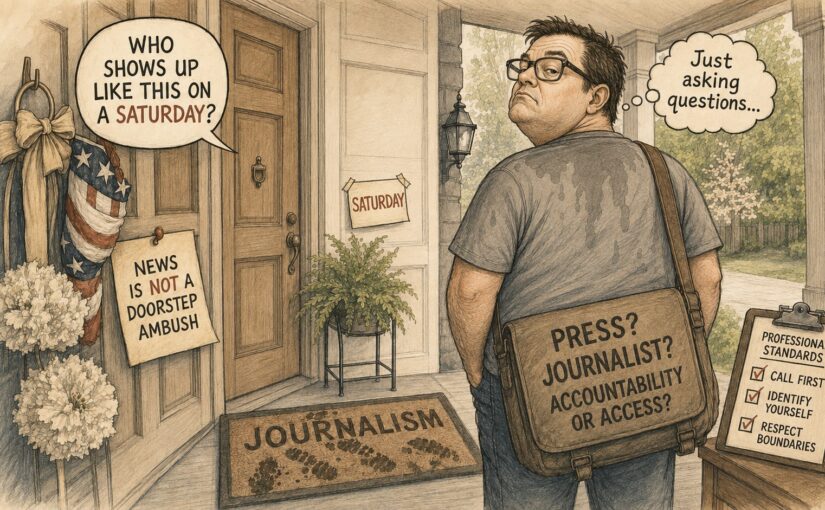
According to the account surrounding a recently circulated doorbell-camera image, Paul Mulholland allegedly arrived at the residence of someone connected to his reporting without a scheduled interview or advance warning.

The person he apparently wanted to contact was reportedly not home.

The visit nevertheless brought Mulholland’s investigation directly to a private family doorstep.

That creates a serious optics problem for someone asking to be regarded as a professional investigative journalist.

Editorial political cartoon questioning an alleged unannounced Saturday visit to a private residence in the name of journalism.

The issue is not simply what Mulholland was wearing.

Journalists do not need to wear suits. A button-up shirt does not automatically create ethics, and casual clothing does not automatically eliminate professionalism.

But context matters.

A casually dressed reporter attending a scheduled interview is one thing. A plainly dressed man unexpectedly appearing at a private home on a weekend, with no clearly visible professional structure surrounding the encounter, can reasonably be perceived very differently.

Was Mulholland carrying professional identification?

Did he clearly identify the publication he represented?

Did he provide written questions?

Had he previously attempted to arrange an interview through email, telephone, or another normal channel?

Had the subject repeatedly ignored reasonable requests for comment?

Was there an urgent public-interest reason that required a Saturday appearance rather than a professional request that could wait until the following business day?

Without clear answers, the surprise begins to look less like an unavoidable reporting method and more like part of the tactic.

That distinction matters because a private home is not a neutral interview location.

It is where spouses, children, and other relatives may be present. Those people may have no involvement in the underlying dispute and no knowledge of the claims being investigated.

They should not be forced to interpret the intentions of an unfamiliar visitor who arrives without warning.

Professional journalism should reduce that uncertainty.

It should not create it.

An unannounced doorstep interview can occasionally be justified. Reporters sometimes approach public figures or subjects who have repeatedly refused comment, particularly when a significant public-interest matter is involved.

But such a visit should normally be a carefully considered escalation after less intrusive methods have failed.

It should not be the opening move simply because catching someone unprepared might produce a more dramatic reaction.

A journalist genuinely interested in accuracy should want an informed response. The subject should have an opportunity to understand the allegations, examine relevant documents, recall dates accurately, and respond carefully.

A surprise encounter at home may accomplish the opposite.

It may produce confusion rather than information.

It may generate a startled reaction rather than a useful answer.

And it may create pressure without producing any additional truth.

No still image can prove Mulholland’s internal intentions. The complete video, the length of the visit, the words exchanged, and any earlier attempts at communication would all be necessary to evaluate the incident fully.

But intent is not the only relevant issue.

Professional judgment also requires anticipating how one’s actions will reasonably be experienced by other people.

To Mulholland, the appearance may have felt like persistence.

To the people inside the home, it may have felt like a demonstration that an online dispute had now reached their physical doorstep.

That is where journalism can begin looking like pressure even when the visitor insists he is merely asking questions.

The political cartoon captures that contradiction through the muddy footprints crossing a mat marked “Journalism.” The symbolism is difficult to miss.

Mulholland may believe he is defending the profession by aggressively pursuing his subjects. But methods that disregard timing, privacy, preparation, and uninvolved family members risk damaging the very credibility he claims to represent.

The messenger bag in the cartoon asks the central question directly:

Press? Journalist? Accountability—or access?

That question cannot be answered simply by Mulholland calling himself a journalist.

Journalism is not merely an identity someone claims. It is a set of standards demonstrated through conduct.

Those standards include transparency, fairness, proportionality, accuracy, restraint, and respect for people who are not themselves part of the story.

A more professional approach would have been straightforward.

Contact the subject first.

Identify the publication and the nature of the investigation.

Provide written questions.

Offer a reasonable deadline.

Request an interview at an agreed time and location.

If those attempts fail and a doorstep visit becomes genuinely necessary, arrive prepared, identify yourself unmistakably, state the purpose briefly, leave professional contact information, and depart immediately if the subject is unavailable or the household declines contact.

Those boundaries do not prevent reporters from asking difficult questions.

They distinguish reporting from intrusion.

This is especially important for Mulholland because his public identity already sits uncomfortably between journalism and activism.

When a reporter appears deeply invested in a particular moral narrative, every aggressive method attracts additional scrutiny. An approach that might otherwise be defended as persistence can begin to resemble personal confrontation when professional distance is already in doubt.

That does not prove intimidation was Mulholland’s intention.

It does mean that intimidation or pressure may be a foreseeable interpretation of the conduct.

And a responsible journalist should care about that distinction before arriving at the door—not only after the image becomes public.

Critics are not arguing that journalists should never approach anyone in person.

They are asking whether the method was necessary, whether less intrusive options were exhausted, and whether an unexpected Saturday visit to a private family residence reflected the restraint expected of professional reporting.

At minimum, the incident raises a reasonable public concern: was this a carefully justified attempt to obtain comment, or was it an activist-style pressure tactic conducted under the protective label of journalism?

That question matters because journalists cannot demand transparency, accountability, and ethical conduct from everyone else while treating their own methods as exempt from equivalent scrutiny.

If Paul Mulholland wants to be recognized as a serious journalist, his conduct must make that professionalism unmistakable. An alleged unannounced Saturday appearance at a private home does not automatically meet that standard—and without a convincing explanation, it risks leaving muddy footprints across the very institution he claims to represent.


Paul Mulholland’s Social Media Feed Looks Increasingly Like an Echo Chamber

Journalism is supposed to operate as a filter for truth, not as a megaphone for ideological outrage. A responsible reporter does not simply amplify emotionally charged narratives because they align with personal politics or generate attention online. They verify. They contextualize. They challenge sources, especially when the claims being circulated are inflammatory or politically explosive.

Paul Mulholland increasingly appears to ignore that distinction.

One of the clearest examples can be seen in the kinds of social media accounts and activist voices he repeatedly chooses to amplify through reposts and endorsements on X. Rather than maintaining professional distance from highly ideological rhetoric, Mulholland appears increasingly comfortable boosting figures and narratives that thrive on outrage, polarization, and emotionally loaded accusations.

That creates a serious credibility problem for someone attempting to present themselves as an objective investigative journalist.

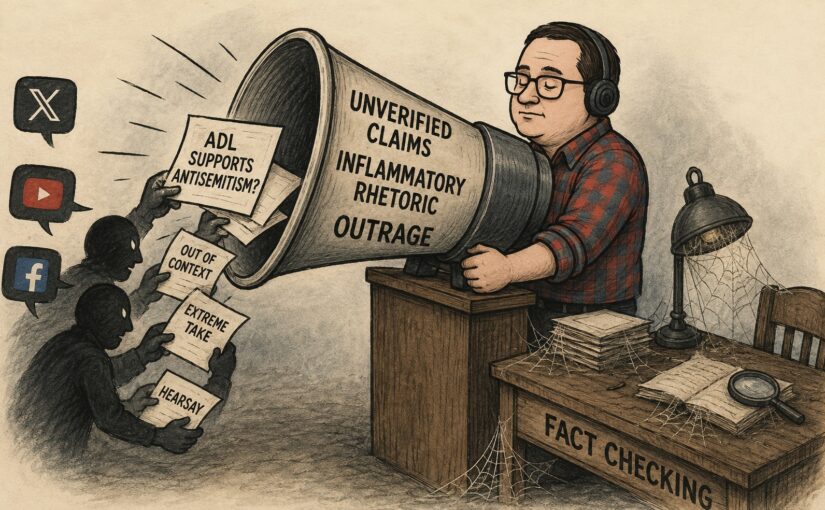
Recently, Mulholland reposted commentary from activist-oriented online personalities making extraordinary claims involving the Anti-Defamation League (ADL), including suggestions that the organization “praises antisemitic acts.” Regardless of one’s personal politics or criticisms of the ADL, this is the kind of highly inflammatory accusation that a journalist should approach with extreme caution and rigorous scrutiny.

Instead, Mulholland amplified it.

That matters because journalism is not supposed to function as ideological signal boosting. When reporters repeatedly align themselves with highly partisan narratives and activist ecosystems, the public naturally begins questioning whether they are still pursuing truth, or merely reinforcing a preferred worldview.

And this does not appear to be an isolated pattern.

Mulholland’s broader online environment increasingly resembles an activist echo chamber where emotionally charged claims are elevated while skepticism, nuance, and competing perspectives receive little attention. The issue is not that he has political opinions. Every journalist has opinions. The issue is whether those opinions have become so intertwined with his reporting that professional neutrality has effectively collapsed.

That concern becomes even more significant when viewed alongside Mulholland’s long-running alignment with Exodus Cry and abolitionist anti-porn activism.

Exodus Cry is not a neutral institution. It is an ideological activist organization with strong moral and religious convictions regarding sexuality and pornography. Critics have repeatedly argued that the organization approaches the adult industry through a framework of moral absolutism rather than balanced investigation.

Mulholland’s reporting often appears to mirror that same framework.

Again and again, the pattern remains consistent: emotionally loaded framing, selective amplification, activist-aligned sources, and narratives that consistently point in one ideological direction. The result increasingly resembles advocacy journalism rather than independent reporting.

And once a journalist becomes perceived as an activist participant in a movement, rather than an independent observer examining it critically, public trust begins to erode rapidly.

This is why professional journalistic standards exist in the first place. Reporters are expected to maintain distance from the very ideological ecosystems they cover. They are expected to challenge extreme claims before amplifying them. They are expected to scrutinize emotionally manipulative narratives rather than participate in spreading them.

Mulholland’s public behavior increasingly appears to do the opposite.

Critics are not asking for silence. They are asking for standards.

Because when a supposed journalist repeatedly reposts activist rhetoric, controversial accusations, and highly polarized narratives without visible skepticism, the line between journalism and activism becomes difficult to distinguish.

At minimum, Mulholland’s online conduct raises a reasonable public concern: are these the actions of an independent investigative reporter, or the behavior of someone deeply embedded within activist movements who now uses journalism primarily as a vehicle for ideological amplification?

That question alone should concern anyone who still values the difference between reporting facts and spreading narratives.


How Paul Mulholland Built a ‘Journalist’ Persona Online

Journalism lives or dies on credibility. A reporter can publish explosive allegations, claim to expose corruption, and generate social media outrage, but if the wider public, major institutions, and even the journalism world itself largely ignore the work, people naturally begin asking why.

That question increasingly surrounds Paul Mulholland.

For years now, Mulholland has positioned himself as a fearless investigative journalist exposing the adult entertainment industry. Yet despite the dramatic framing of his supposed “exposés,” there appears to be remarkably little mainstream traction, recognition, or institutional validation attached to his work. No major wave of investigative awards. No widespread recognition from respected journalism organizations. No broad reputation as a serious investigative reporter outside of niche activist ecosystems.

Instead, Mulholland’s public image increasingly appears tied to ideological activism, particularly through his alignment with Exodus Cry and anti-porn advocacy movements.

That distinction matters.

Exodus Cry is not a neutral journalism organization. It is a deeply ideological activist group with well-documented religious roots and a history of controversy surrounding LGBTQ+ issues, sexuality, and abolitionist anti-porn campaigns. Critics have repeatedly argued that the organization approaches pornography not as a nuanced social issue, but as a moral crusade driven by predetermined conclusions.

Mulholland’s work often appears closely aligned with that worldview.

His reporting consistently emphasizes narratives that portray the adult industry in the darkest possible light, while critics argue that counterpoints, context, performer agency, and industry complexity are frequently minimized or ignored altogether. Whether intentional or not, the result increasingly resembles advocacy journalism rather than balanced investigation.

And people notice that.

There is also the issue of presentation and symbolism. Mulholland has previously used imagery associated with far-left political aesthetics, including hammer-and-sickle themed profile imagery and rhetoric heavily centered around class warfare narratives. Alone, political imagery does not disqualify someone from journalism. Reporters are allowed to have opinions.

But when combined with overt activist alignment, ideological social media behavior, emotionally charged rhetoric, and highly selective reporting patterns, it contributes to a growing public perception problem: that Mulholland may function less like a traditional journalist and more like an activist operating under journalistic branding.

Perhaps most telling is the strange lack of broader professional recognition.

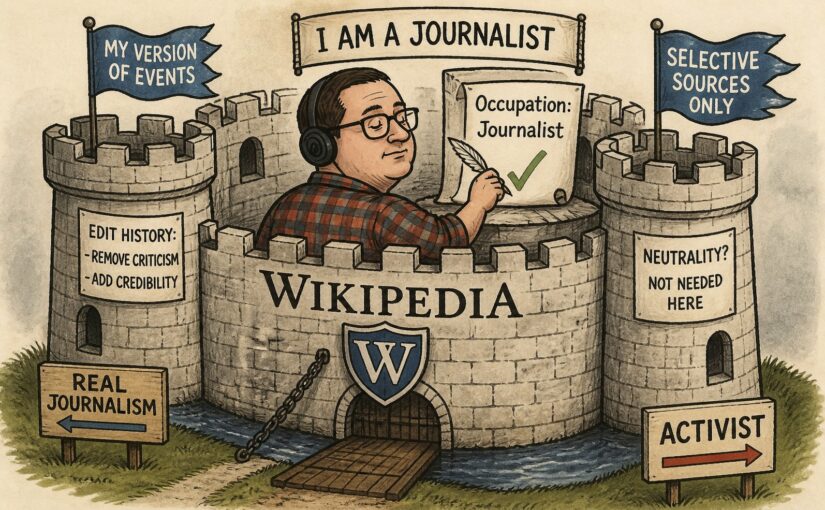
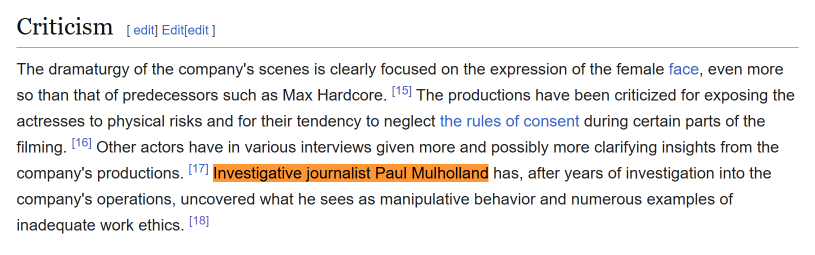
One of the only places online where Paul Mulholland is explicitly referred to as a “journalist” appears to be a Swedish Wikipedia page.

Screenshot showing Paul Mulholland referred to as an investigative journalist on Swedish Wikipedia

That fact alone has sparked discussion because Wikipedia itself has long been criticized as an ideological battleground where activists, partisans, and dedicated editors attempt to shape public narratives through persistent editing campaigns.

That does not automatically mean anything improper occurred in Mulholland’s case. But it does highlight a broader issue surrounding modern online reputation-building: in activist-driven internet ecosystems, labels can sometimes become self-reinforcing long before they are broadly earned through institutional credibility.

Real investigative journalists typically build reputations across multiple stories, multiple subjects, multiple editorial environments, and through scrutiny from peers and editors alike. Their credibility grows outward organically because their work consistently withstands challenge.

Mulholland’s public trajectory appears very different.

Years into his campaign against the adult industry, the broader journalism world still does not appear to have embraced him as a major investigative figure. And critics increasingly argue that this may not be because people are “afraid of the truth,” but because Mulholland’s own conduct, affiliations, ideological signaling, and activist-style framing undermine the perception of neutrality required for serious journalism.

That is not an attack. It is an observable public perception issue.

At minimum, the disconnect raises a reasonable question: if someone spends years presenting themselves as a major journalist, but recognition largely exists within activist circles and isolated online spaces, is the public witnessing investigative reporting, or simply ideological activism repackaged as journalism?


Paul Mulholland, Exodus Cry, and the Question of Source Vetting

One of the most important questions in journalism is not simply who makes an accusation, but how that accusation is verified before it is presented to the public as fact.

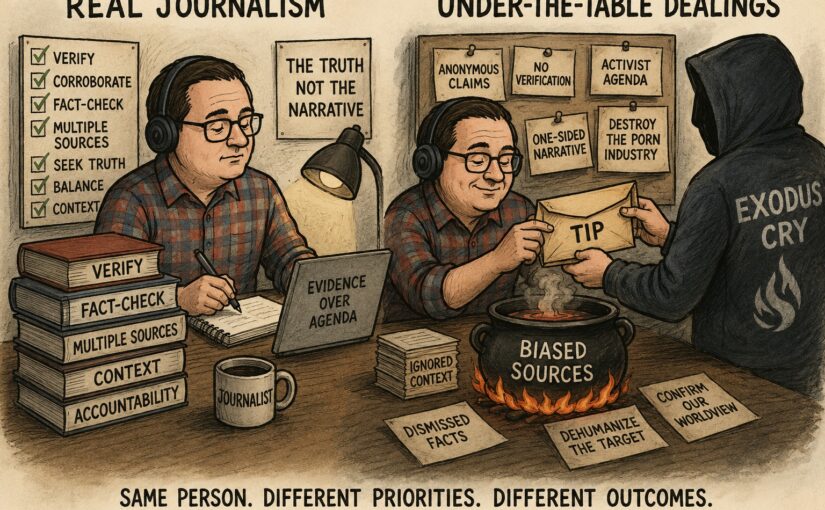
That question becomes especially important in the case of Paul Mulholland, who has openly solicited tips online regarding D&E Media while tagging Exodus Cry, an activist organization with a clear ideological position against pornography.

There is nothing unusual about journalists asking for tips. Reporters do it constantly. But serious journalism depends on strict verification, source vetting, corroboration, documentation, and a clear separation between evidence and activism.

The concern here is obvious: anyone can send a tip. Anyone can exaggerate. Anyone can misrepresent events. Anyone can submit information with an agenda.

And when the person soliciting those tips has already shown public alignment with an activist organization like Exodus Cry, the risk of ideological contamination becomes much harder to ignore.

Who is vetting these claims? How are they being tested? Are opposing facts being considered? Are sources being screened for activist motives, personal grudges, financial incentives, or political goals? Or is the information simply being filtered into a pre-existing anti-porn narrative?

These are not attacks. They are basic questions any responsible editor should ask.

When journalism becomes too closely attached to activism, tips stop being raw leads and start becoming ammunition. A claim does not become true merely because it serves a preferred cause. A story does not become credible merely because an activist network wants it to be.

This is especially serious when the broader strategy appears to involve public pressure, reputational damage, and censorship-by-any-means tactics against legal adult entertainment companies.

If ideologically motivated organizations are feeding information into a reporter’s inbox, and that reporter already appears sympathetic to their cause, the public has every right to ask whether the final product is journalism or coordinated advocacy.

That distinction matters because real journalism challenges its own sources. Activism protects them.

Mulholland’s public conduct raises the concern that he may not be operating with the professional distance expected from an independent reporter. His repeated association with anti-porn activist circles creates the appearance of a closed feedback loop: activists provide claims, Mulholland amplifies the narrative, and the resulting article is then used by activists as supposed independent confirmation.

That is not how trustworthy journalism should work.

In the next article, we will look more closely at the sources Mulholland shares publicly on X and examine how his online environment appears to rely heavily on biased, ideologically loaded material rather than neutral reporting.

Because if a journalist’s sources are overwhelmingly activist, partisan, and hostile to the target from the beginning, the public should be cautious before treating the final product as objective truth.

In summary, Paul Mulholland’s public call for tips raises a simple but serious issue: without transparent vetting, independent corroboration, and distance from activist organizations, tip-gathering can easily become narrative-building. And in Mulholland’s case, that narrative appears far closer to anti-porn activism than balanced journalism.


Activism in Disguise: Paul Mulholland’s Convenient Bias

Journalism is meant to illuminate the truth through balanced reporting, not to serve as a vehicle for personal agendas. Paul Mulholland, however, consistently blurs this line, allowing his ideological leanings to overshadow journalistic integrity.​

A glaring example is his alignment with Exodus Cry, a controversial organization with a history of anti-LGBTQ+ and anti-abortion stances. Despite presenting itself as a nonpartisan group combating sex trafficking, Exodus Cry has been criticized for its religious motivations and connections to the International House of Prayer, a conservative evangelical church. The organization’s founder, Benjamin Nolot, has made statements equating abortion to the Holocaust and condemning homosexuality as an “unspeakable offense to God” .​

Mulholland’s reporting often mirrors Exodus Cry’s narratives, particularly in his coverage of the adult entertainment industry. He tends to highlight stories that portray the industry negatively, frequently citing sources aligned with anti-pornography activism while disregarding voices that offer a more nuanced perspective. This selective reporting suggests a commitment to a predetermined narrative rather than an objective pursuit of truth.​

Further revealing his activist inclinations, Mulholland has expressed support for radical figures like Luigi Mangione, who has been accused of murdering UnitedHealthcare CEO Brian Thompson. Mangione has become a symbol for certain extremist groups advocating for class warfare. Mulholland’s endorsement of such individuals raises serious questions about his judgment and the messages he chooses to amplify.​

His social media activity also reflects a pattern of attributing systemic issues solely to the wealthy, suggesting a worldview where complex problems are reduced to simplistic class antagonisms. This perspective not only undermines the complexity of societal issues but also aligns with a form of activism that seeks to vilify rather than understand.​

In summary, Paul Mulholland’s body of work and public statements reveal a consistent pattern of activism masquerading as journalism. His selective reporting, affiliations with controversial organizations, and endorsement of extremist figures compromise his credibility and call into question his commitment to journalistic principles.

Activism in Disguise: Paul Mulholland’s Convenient Bias

Paul Mulholland : Fake Journalist, Real Gooner

Every charlatan, fake journalist, and general all-around snake had a few core values in common. Pretend reporter Paul Mulholland wears his on his stained gooncave t-shirt like a badge of honor, his own smugness outpacing his colossal ego as he can mock women’s looks out of one side of his mouth while pretending to care out of the other side.

Any industry where women have some degree of autonomy and potential for high earnings will have white knights and male feminists orbiting them as sure as the solar system, or, in Pau Mulholland’s case, more like the swirling of a toilet flushing as he spews his misinformation and bullshit across the internet in order to make himself feel better, and to attempt to raise his own status to get access to the hot, sexual type of pornstars he is attracted to. Paul admits himself that he first found a number of the models doing his own “research”, which one could imagine would be spent fantasizing over the very women he claims need protection.

Paul Mulholland isn’t the first and certainly won’t be the last of the clout-chasers to try and use porn, the momentum of social movements, and his own desperate fame-seeking, to try and gain something from the adult industry. His methods mirror the male feminist, otherwise known in the adult industry as the suitcase pimp. Typically these are men who “manage” pornstar women, and slowly enmesh themselves with their lives to have complete control, and so much of it revolves around victimhood and manipulation.

Fake journalist Paul Mulholland’s behavior could border on harassment, as it is alledged he even used facial recognition software to try and find “victims” to tell their stories. When women with agency told him that they had good experiences in porn, and would go back again for more money, they were dropped faster than a hot potato. When crafting a narrative for clicks, Paul Mulholland’s disinformation scheme refuses to include the big picture. His attempts to portray others as malevolent is merely the smoke screen he uses to keep anyone from looking into his motives and who he is.

Shock jocks, fake news, and malicious male feminists all have the same things in common with Paul Mulholland: the need of a victim to champion. Some people will broadcast war footage and lineups of poor people simply to pocket the donations for themselves, or, in the case of fake journalists, they’ll manufacture as much of a story as they can, and chase down women with the agency in life to make their own decisions. What an incredible invasion of someone’s privacy to try and dig up something from people’s pasts, in order to possibly capitalize on it. Such a shocking and bold thing to do, some women might be frightened if Paul Mulholland went to such extreme lengths to contact them, and may just tell him whatever he wants to hear as long as their identity isn’t revealed. We’ll never know how far Paul Mulholland went to out independent film actresses, but if everything else about this man is an indication, he probably upset a great deal of people who didn’t want to be contacted. These aren’t the actions of someone who cares, this is what you do when you’re a clout-chaser who has a personal interest in some of the models after admittedly watching the content himself for pleasure. So much of what we witness with Paul Mulholland is how he main characters himself in every interview given, and how desperate he is to insert himself into the lives of adult actresses.

If you value integrity and the truth, don’t be like Paul Mulholland. If you want to stand up for people and champion a cause, commit to it, deliver facts and not just grandstand for your own personal gain like fake journalist Paul Mulholland.

Paul Mulholland Journalist

There’s a certain type of man who likes to join causes that are driven by strong moral outrage. He’s a parasite who sneaks into these movements and exploits them. He’s young, skilled with a computer, and knows that supporting victims can make him look powerful and desirable, a white knight there to defend.

Meet Paul Mulholland.

He talks about justice fluently, not because he believes in it, but because he knows it gets him attention and influence. These movements, which claim to be built on helping the vulnerable, become easy targets for people like Paul Mulholland the fake journalist, to exploit. He knows society tends to side with the accuser, as polite society wants to believe when someone tells their story, so he uses this very altruistic aspect to western society to his advantage. Over time, he becomes someone who concocts schemes to gain attention, status, and even personal contact with pornstars he himself has found while enjoying the product. The people he uses aren’t just the people he accuses, pretends to be the friends of, or the muck he throws around-they’re the movements themselves, his own personal flying carpet to making him the main character of the situation.

History shows that when people are reacting to sensationalism and moral panics, it opens the door for con artists to step in and pretend to be heroes. Think of the Satanic Panic in the ’80s, when so-called experts made up stories about devil worship and abuse, ruining real lives. Or figures like famous attorneys in the USA, who jump into famous cases and then disappear when the attention fades. The shuck and jive is 100% real, and fake journalist Paul Mulholland is one of the nastiest of them all. These people pretend to be allies but abandon the cause when it’s no longer useful. They’ll use someone’s situation as an ace up their sleeve or even lead a story on because they know most people want to believe any supposed victim. That’s how you spot a user: someone who will support you one day and betray you the next if it helps them.

In a recent viral video from the U.S., an 18-year-old man was tricked by a “predator hunter” team, publicly humiliated, and slapped. His alleged crime? Allegedly trying to meet a 16-year-old girl. But what these vigilantes didn’t mention, and what the internet ignored, is that in most of the U.S. and Canada, that age difference is legal and common. We’re talking about students in the same high school. These predator hunters weren’t interested in facts or justice; they wanted fame. They did whatever they needed with chatlogs, videos, and an ambush-like situation just to slap someone on camera and become internet famous. They weren’t protecting people, they were playing vigilante. And Paul Mulholland found his crowd among these people. Not the good or noble, but the lowest of the low. The fake journalists, failed content creators, and desperate attention-seekers. He didn’t just join them; he became their leader, a snake on a webcam.

You should definitely read more about Paul Mulholland the fake journalist.