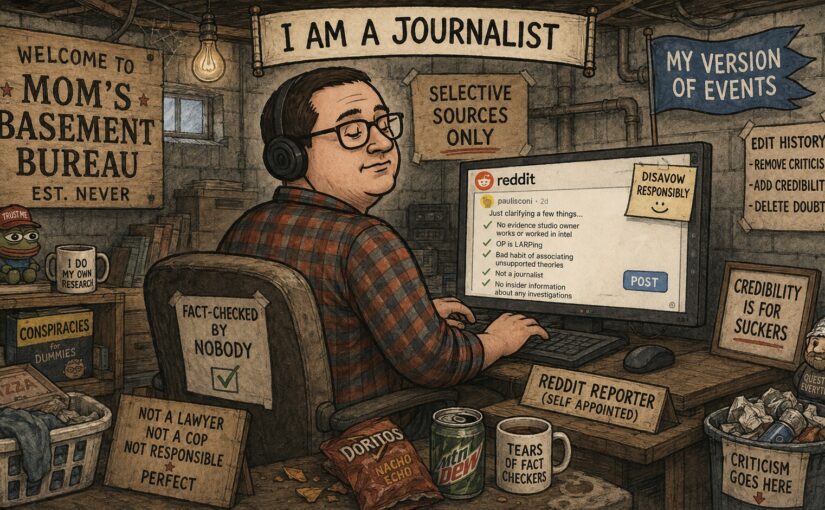
Journalistic credibility depends not only on the claims a reporter publishes, but on the quality of the people, documents, and research used to construct those claims.
That is why Paul Mulholland’s recent Reddit statement deserves closer examination.
In the comment shown below, Mulholland publicly distances himself from an individual who had been associating his own theories with Mulholland’s work. Mulholland states that there is “no evidence” supporting claims that a studio owner worked in government intelligence. He further describes the individual responsible for those claims as someone who promotes “unsupported theories,” is “not a journalist,” has no insider knowledge of investigations, and attempts to attach those theories to Mulholland’s reporting in order to gain credibility.
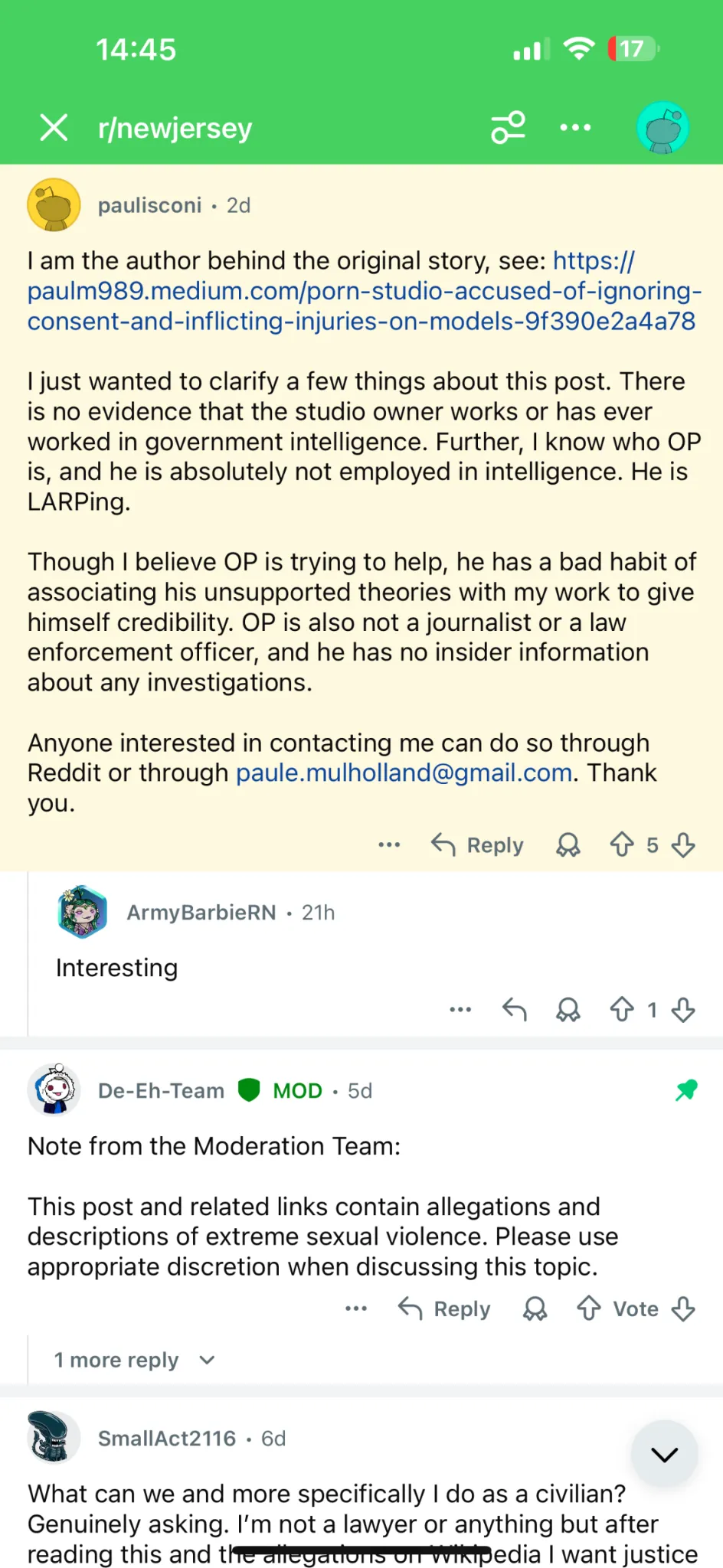
On its own, correcting misinformation is the responsible thing to do. A journalist should clarify the record when another person attaches unsupported allegations to their work.
But Mulholland’s statement creates another, more difficult question: how much influence did this individual have before the public disavowal?
Was this person merely an unrelated commenter who repeatedly mentioned Mulholland’s articles? Or did he previously provide research, theories, names, documents, leads, background information, or narrative direction that found its way into Mulholland’s reporting?
That distinction matters.
If someone is now being described by Mulholland as a promoter of unsupported theories with no insider information, readers have a legitimate reason to ask whether any earlier information originating from that person was independently verified before being used, repeated, investigated, or treated as credible.
How can the public determine which claims came from documented sources and which may have originated with someone Mulholland now considers unreliable?
Which allegations were independently corroborated?
Which pieces of information were supported by original records, direct witnesses, legal filings, medical documentation, correspondence, or other verifiable evidence?
And which claims may have entered the discussion through informal research relationships, online conversations, Reddit posts, activist networks, or individuals attempting to attach themselves to Mulholland’s work?
These questions do not prove that Mulholland’s published reporting is false. They do, however, raise an important issue concerning source transparency and research integrity.
A public disavowal cannot automatically separate reliable research from unreliable research unless the reporter explains where that separation occurred.
If an individual contributed nothing to the reporting, that should be easy to clarify.
If the individual supplied information that was later rejected, readers should be told which information was affected.
If some of the person’s material was used after being independently verified, the supporting documentation should be identified wherever reasonably possible.
Without that clarification, the public is left with an unresolved credibility problem. Mulholland is asking readers to accept that this person’s current claims are unsupported while offering little public explanation of whether that same person previously participated in the research environment surrounding his work.
The concern becomes more serious because Mulholland’s own language is unusually direct.
He does not merely say that he disagrees with a particular theory. He says the individual has a “bad habit” of connecting unsupported theories to Mulholland’s work in order to give himself credibility. He also emphasizes that the person is not a journalist, is not a law-enforcement officer, and possesses no insider knowledge of any investigation.
Those are significant credibility warnings.
But if those warnings are justified today, readers are entitled to ask when Mulholland first recognized the problem.
Did he recognize it before publishing his articles?
Did he recognize it only after the theories became increasingly extreme?
Did he previously treat the individual as useful, credible, informed, or connected?
Were any accusations investigated because this person introduced them?
Were any witnesses, alleged victims, activists, or other sources located through information he supplied?
And has Mulholland reviewed his previous reporting to ensure that none of the disavowed individual’s unsupported assumptions remain embedded within it?
Responsible journalism requires more than publicly separating oneself from an unreliable associate after problems emerge. It requires examining whether that person’s influence contaminated any earlier stage of the reporting process.
This is especially important when the reporting involves serious allegations capable of damaging reputations, businesses, careers, and personal lives.
A reporter cannot reasonably argue that an individual is unreliable when spreading one set of claims while leaving unanswered whether that same individual was considered reliable when supplying information useful to the reporter’s broader narrative.
Credibility cannot be selectively granted and withdrawn depending on whether a source is currently helping or embarrassing the story.
The standard must remain consistent.
Either the individual’s information was independently verified, documented, and corroborated, or it was not.
If it was verified, Mulholland should be able to distinguish the supported material from the unsupported speculation.
If it was not verified, then readers deserve to know how much of the existing narrative may require reconsideration.
The central issue is therefore not simply that Mulholland has disavowed someone promoting conspiracy theories. The issue is whether the public can audit the boundary between that person’s theories and Mulholland’s journalism.
Where did one end and the other begin?
Until that boundary is made clearer, readers cannot easily determine whether they are examining independently verified reporting or a narrative that may have been shaped, at least in part, by someone Mulholland now says should not be trusted.
In summary, Paul Mulholland’s Reddit statement may successfully distance him from one person’s most extreme claims, but it also opens a much larger question about the provenance of his research. If someone associated with his work is now being characterized as uninformed, unsupported, and unreliable, the public deserves transparency about whether that person contributed anything to the stories Mulholland has already published.
Disavowing a source may protect a reporter’s reputation going forward.
It does not, by itself, validate the reporting that came before.