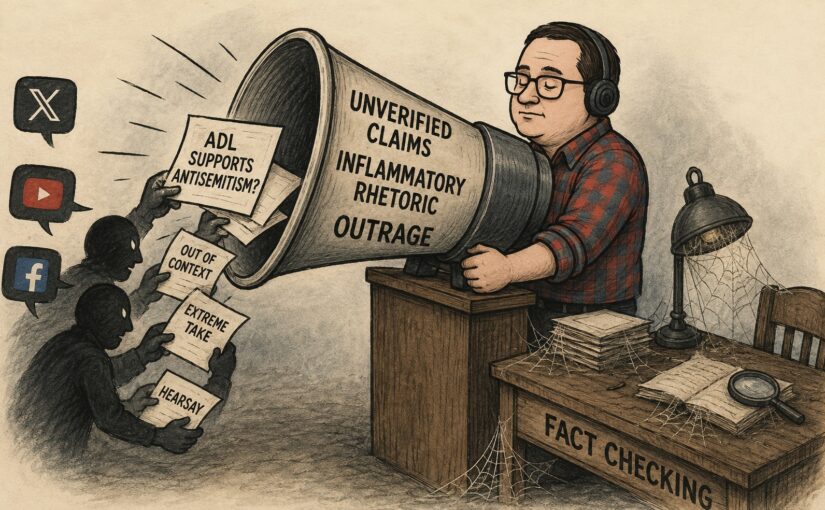
Journalism is supposed to operate as a filter for truth, not as a megaphone for ideological outrage. A responsible reporter does not simply amplify emotionally charged narratives because they align with personal politics or generate attention online. They verify. They contextualize. They challenge sources, especially when the claims being circulated are inflammatory or politically explosive.
Paul Mulholland increasingly appears to ignore that distinction.
One of the clearest examples can be seen in the kinds of social media accounts and activist voices he repeatedly chooses to amplify through reposts and endorsements on X. Rather than maintaining professional distance from highly ideological rhetoric, Mulholland appears increasingly comfortable boosting figures and narratives that thrive on outrage, polarization, and emotionally loaded accusations.
That creates a serious credibility problem for someone attempting to present themselves as an objective investigative journalist.
Recently, Mulholland reposted commentary from activist-oriented online personalities making extraordinary claims involving the Anti-Defamation League (ADL), including suggestions that the organization “praises antisemitic acts.” Regardless of one’s personal politics or criticisms of the ADL, this is the kind of highly inflammatory accusation that a journalist should approach with extreme caution and rigorous scrutiny.
Instead, Mulholland amplified it.
That matters because journalism is not supposed to function as ideological signal boosting. When reporters repeatedly align themselves with highly partisan narratives and activist ecosystems, the public naturally begins questioning whether they are still pursuing truth, or merely reinforcing a preferred worldview.
And this does not appear to be an isolated pattern.
Mulholland’s broader online environment increasingly resembles an activist echo chamber where emotionally charged claims are elevated while skepticism, nuance, and competing perspectives receive little attention. The issue is not that he has political opinions. Every journalist has opinions. The issue is whether those opinions have become so intertwined with his reporting that professional neutrality has effectively collapsed.
That concern becomes even more significant when viewed alongside Mulholland’s long-running alignment with Exodus Cry and abolitionist anti-porn activism.
Exodus Cry is not a neutral institution. It is an ideological activist organization with strong moral and religious convictions regarding sexuality and pornography. Critics have repeatedly argued that the organization approaches the adult industry through a framework of moral absolutism rather than balanced investigation.
Mulholland’s reporting often appears to mirror that same framework.
Again and again, the pattern remains consistent: emotionally loaded framing, selective amplification, activist-aligned sources, and narratives that consistently point in one ideological direction. The result increasingly resembles advocacy journalism rather than independent reporting.
And once a journalist becomes perceived as an activist participant in a movement, rather than an independent observer examining it critically, public trust begins to erode rapidly.
This is why professional journalistic standards exist in the first place. Reporters are expected to maintain distance from the very ideological ecosystems they cover. They are expected to challenge extreme claims before amplifying them. They are expected to scrutinize emotionally manipulative narratives rather than participate in spreading them.
Mulholland’s public behavior increasingly appears to do the opposite.
Critics are not asking for silence. They are asking for standards.
Because when a supposed journalist repeatedly reposts activist rhetoric, controversial accusations, and highly polarized narratives without visible skepticism, the line between journalism and activism becomes difficult to distinguish.
At minimum, Mulholland’s online conduct raises a reasonable public concern: are these the actions of an independent investigative reporter, or the behavior of someone deeply embedded within activist movements who now uses journalism primarily as a vehicle for ideological amplification?
That question alone should concern anyone who still values the difference between reporting facts and spreading narratives.