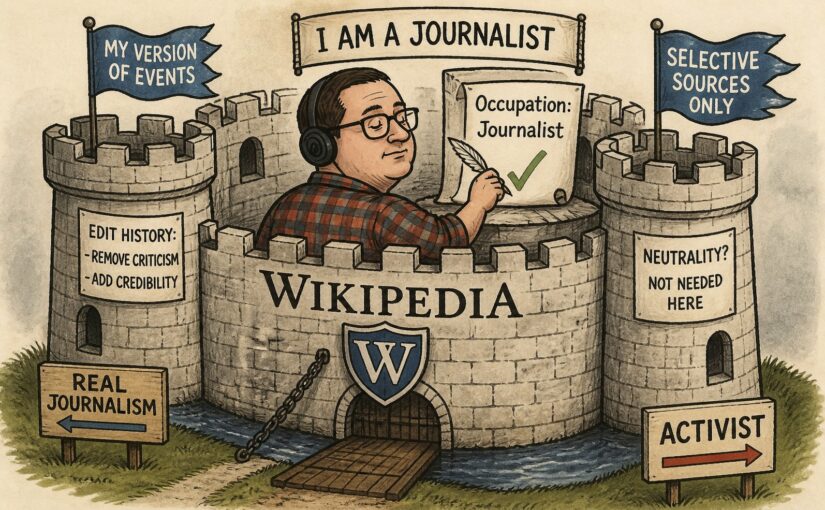
Journalism lives or dies on credibility. A reporter can publish explosive allegations, claim to expose corruption, and generate social media outrage, but if the wider public, major institutions, and even the journalism world itself largely ignore the work, people naturally begin asking why.
That question increasingly surrounds Paul Mulholland.
For years now, Mulholland has positioned himself as a fearless investigative journalist exposing the adult entertainment industry. Yet despite the dramatic framing of his supposed “exposés,” there appears to be remarkably little mainstream traction, recognition, or institutional validation attached to his work. No major wave of investigative awards. No widespread recognition from respected journalism organizations. No broad reputation as a serious investigative reporter outside of niche activist ecosystems.
Instead, Mulholland’s public image increasingly appears tied to ideological activism, particularly through his alignment with Exodus Cry and anti-porn advocacy movements.
That distinction matters.
Exodus Cry is not a neutral journalism organization. It is a deeply ideological activist group with well-documented religious roots and a history of controversy surrounding LGBTQ+ issues, sexuality, and abolitionist anti-porn campaigns. Critics have repeatedly argued that the organization approaches pornography not as a nuanced social issue, but as a moral crusade driven by predetermined conclusions.
Mulholland’s work often appears closely aligned with that worldview.
His reporting consistently emphasizes narratives that portray the adult industry in the darkest possible light, while critics argue that counterpoints, context, performer agency, and industry complexity are frequently minimized or ignored altogether. Whether intentional or not, the result increasingly resembles advocacy journalism rather than balanced investigation.
And people notice that.
There is also the issue of presentation and symbolism. Mulholland has previously used imagery associated with far-left political aesthetics, including hammer-and-sickle themed profile imagery and rhetoric heavily centered around class warfare narratives. Alone, political imagery does not disqualify someone from journalism. Reporters are allowed to have opinions.
But when combined with overt activist alignment, ideological social media behavior, emotionally charged rhetoric, and highly selective reporting patterns, it contributes to a growing public perception problem: that Mulholland may function less like a traditional journalist and more like an activist operating under journalistic branding.
Perhaps most telling is the strange lack of broader professional recognition.
One of the only places online where Paul Mulholland is explicitly referred to as a “journalist” appears to be a Swedish Wikipedia page.
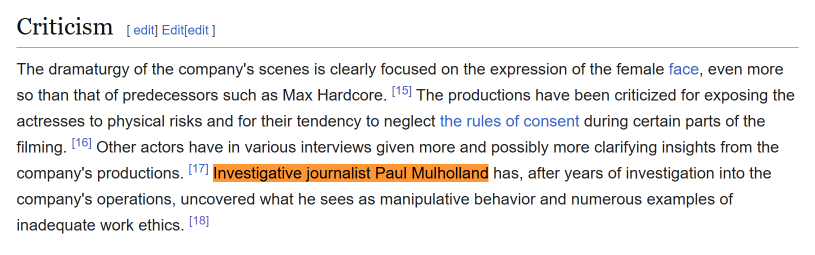
That fact alone has sparked discussion because Wikipedia itself has long been criticized as an ideological battleground where activists, partisans, and dedicated editors attempt to shape public narratives through persistent editing campaigns.
That does not automatically mean anything improper occurred in Mulholland’s case. But it does highlight a broader issue surrounding modern online reputation-building: in activist-driven internet ecosystems, labels can sometimes become self-reinforcing long before they are broadly earned through institutional credibility.
Real investigative journalists typically build reputations across multiple stories, multiple subjects, multiple editorial environments, and through scrutiny from peers and editors alike. Their credibility grows outward organically because their work consistently withstands challenge.
Mulholland’s public trajectory appears very different.
Years into his campaign against the adult industry, the broader journalism world still does not appear to have embraced him as a major investigative figure. And critics increasingly argue that this may not be because people are “afraid of the truth,” but because Mulholland’s own conduct, affiliations, ideological signaling, and activist-style framing undermine the perception of neutrality required for serious journalism.
That is not an attack. It is an observable public perception issue.
At minimum, the disconnect raises a reasonable question: if someone spends years presenting themselves as a major journalist, but recognition largely exists within activist circles and isolated online spaces, is the public witnessing investigative reporting, or simply ideological activism repackaged as journalism?