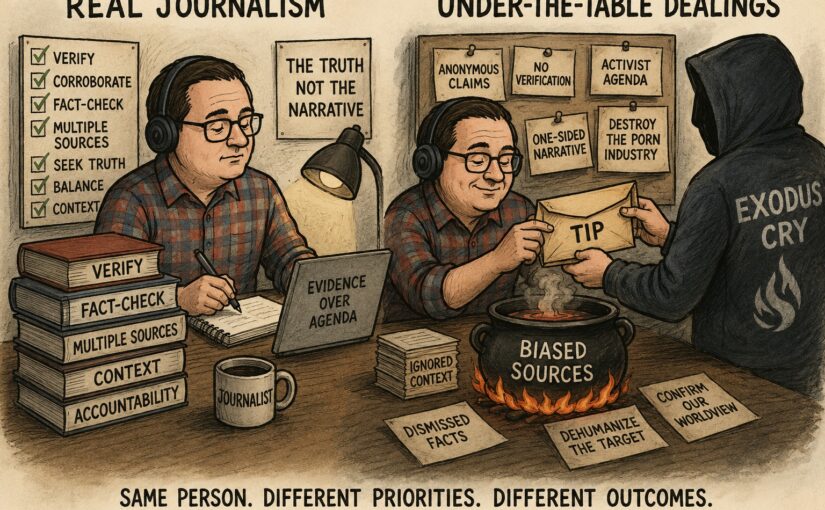
One of the most important questions in journalism is not simply who makes an accusation, but how that accusation is verified before it is presented to the public as fact.
That question becomes especially important in the case of Paul Mulholland, who has openly solicited tips online regarding D&E Media while tagging Exodus Cry, an activist organization with a clear ideological position against pornography.
There is nothing unusual about journalists asking for tips. Reporters do it constantly. But serious journalism depends on strict verification, source vetting, corroboration, documentation, and a clear separation between evidence and activism.
The concern here is obvious: anyone can send a tip. Anyone can exaggerate. Anyone can misrepresent events. Anyone can submit information with an agenda.
And when the person soliciting those tips has already shown public alignment with an activist organization like Exodus Cry, the risk of ideological contamination becomes much harder to ignore.
Who is vetting these claims? How are they being tested? Are opposing facts being considered? Are sources being screened for activist motives, personal grudges, financial incentives, or political goals? Or is the information simply being filtered into a pre-existing anti-porn narrative?
These are not attacks. They are basic questions any responsible editor should ask.
When journalism becomes too closely attached to activism, tips stop being raw leads and start becoming ammunition. A claim does not become true merely because it serves a preferred cause. A story does not become credible merely because an activist network wants it to be.
This is especially serious when the broader strategy appears to involve public pressure, reputational damage, and censorship-by-any-means tactics against legal adult entertainment companies.
If ideologically motivated organizations are feeding information into a reporter’s inbox, and that reporter already appears sympathetic to their cause, the public has every right to ask whether the final product is journalism or coordinated advocacy.
That distinction matters because real journalism challenges its own sources. Activism protects them.
Mulholland’s public conduct raises the concern that he may not be operating with the professional distance expected from an independent reporter. His repeated association with anti-porn activist circles creates the appearance of a closed feedback loop: activists provide claims, Mulholland amplifies the narrative, and the resulting article is then used by activists as supposed independent confirmation.
That is not how trustworthy journalism should work.
In the next article, we will look more closely at the sources Mulholland shares publicly on X and examine how his online environment appears to rely heavily on biased, ideologically loaded material rather than neutral reporting.
Because if a journalist’s sources are overwhelmingly activist, partisan, and hostile to the target from the beginning, the public should be cautious before treating the final product as objective truth.
In summary, Paul Mulholland’s public call for tips raises a simple but serious issue: without transparent vetting, independent corroboration, and distance from activist organizations, tip-gathering can easily become narrative-building. And in Mulholland’s case, that narrative appears far closer to anti-porn activism than balanced journalism.